


These general terms and conditions of sale (“General Terms and Conditions”) apply to all sales of Products (as defined below) made by VALENTE S.r.l. (“Seller”) to any party not falling within the definition of “consumer” as set out in Article 3 of Legislative Decree No. 206 of 6 September 2005, as amended and supplemented (“Customer”). Unless expressly waived in writing, they shall prevail over any other conflicting clause contained in standard forms or other documents used by the Seller and/or the Customer (collectively, the “Parties”).
1. DEFINITIONS
1.1 The following terms, as used in these General Terms and Conditions of Sale (GTC), shall have the following meanings:
2. PRODUCTS
2.1 The subject matter of the sales regulated by these General Terms and Conditions are the products listed in the Seller’s price lists in force at the time the Customer places the purchase order (“Products”).
2.2 The provision of catalogues, price lists or designs does not constitute a formal offer on the part of the Seller, who remains free to amend them at any time and without prior notice. Unless otherwise agreed in writing, any information or data regarding the characteristics and/or technical specifications of the Products contained in price lists, catalogues or other illustrative material provided by the Seller shall not be binding.
2.3 The Seller may make any changes to the Products that may prove necessary or appropriate, without, however, altering their essential characteristics.
3. ORDERS AND CONFIRMATIONS
3.1 Offers shall remain valid for the period specified in the Contract and/or the Offer and/or the Order Confirmation, unless otherwise confirmed in writing by the Seller. The Seller reserves the right to cancel or revise offers at any time prior to issuing a written confirmation of acceptance of the order.
3.2 The Customer shall place orders by completing and submitting the appropriate forms provided by the Seller or by sending a specific notification by post, fax or email.
3.3 Each order, order proposal or supply request constitutes an irrevocable contractual offer and shall be deemed firm and binding on the Customer pursuant to Article 1329 of the Italian Civil Code until confirmed by the Seller and, in any event, no later than 30 (thirty) days from its receipt, with the Seller being free to accept or reject the order at its sole discretion. Orders and/or amendments to orders made verbally or by telephone must be confirmed in writing by the Customer. Proposals received through agents, collaborators or brokers are always deemed to have been received “subject to the Seller’s approval”.
3.4 Orders shall be deemed accepted upon the Customer’s receipt of the order confirmation issued by the Seller (“Order Confirmation”).
3.5 Should the Order Confirmation contain any changes to the order, such changes shall be deemed tacitly accepted 5 (five) working days after receipt of the Order Confirmation, provided the Customer has not expressed their objection in writing.
3.6 In the event of cancellation of an order or failure to collect the Products, even partially, the Customer shall pay a penalty equal to 30% of the value of the cancelled orders and/or the uncollected Products, without prejudice to the Seller’s right to claim compensation for any further loss.
3.7 The delivery of a quantity of Products that exceeds or is less than 5% of the quantity ordered and accepted shall be deemed to comply with the order.
3.8 Without prejudice to the fulfilment of orders already confirmed, the Seller may suspend and/or discontinue the production of the Products at any time and without notice, without the Customer being entitled to make any claim or complaint.
4. SALES PRICES
4.1 Unless otherwise agreed in writing, the price of the Products (“Price”) shall be that set out in the Seller’s price list in force at the time of dispatch of the Order Confirmation.
4.2 The Price is quoted in euros (EUR).
5. TERMS OF PAYMENT
5.1 Within 5 (five) working days from receipt of the Order Confirmation, the Customer shall pay the Seller a deposit equal to 20% of the total Price due for the Products ordered. Unless otherwise agreed in writing, the balance of the remaining Price shall be paid prior to delivery in accordance with the agreed delivery terms (e.g., if the delivery terms are FCA Incoterms® 2020, the balance shall be paid prior to the Products being loaded onto the carrier’s vehicle).
5.2 Notwithstanding the provisions of paragraph 5.1, where the Parties have agreed that payment is to be made, in whole or in part, after delivery of the Products, the Customer shall provide the Seller, within 5 (five) working days from receipt of the Order Confirmation, with a suitable, independent, first-demand guarantee issued by a leading bank in a country not considered at risk for the full amount of the Price not yet paid or, alternatively, a standby letter of credit, in accordance with the terms and conditions specified in the Order Confirmation.
5.3 Confirmed orders shall not be binding on the Seller until the deposit has been paid or the guarantee/letter of credit has been provided within the time limits specified in paragraphs 5.1 and 5.2 respectively.
5.4 Where payment is made by documentary credit, this must be issued in accordance with the terms and conditions specified by the Seller in the Order Confirmation on a case-by-case basis.
6. FAILURE TO PAY OR DELAYED PAYMENT
6.1 In the event of a total or partial delay in payment, the Customer shall be required to pay the Seller interest on arrears, calculated on the amount due and invoiced, in accordance with Article 5 of Legislative Decree 231/2002.
6.2 Should the Customer fail to make a payment, in whole or in part, including in respect of previous supplies, the Supplier may suspend any deliveries currently in progress, terminate the relevant contract and retain any sums received in advance by way of compensation, without prejudice to the right to claim compensation for further damages.
6.3 In the event of payment of the Price by instalments, failure by the Customer to meet even a single payment deadline, as well as any reduction in the guarantees provided, shall automatically result in the forfeiture of the benefit of the term in respect of any sum owed by the Customer to the Seller, including with reference to previous supplies.
7. RETENTION OF TITLE
7.1 The Products remain the property of the Seller until the Customer has paid in full the Price for all Products supplied and, in the exceptional case of payment made by bill of exchange or cheque, until the Seller has received notification from the Bank that the bills of exchange and cheques have been definitively honoured. Nevertheless, all risks arising from loss of or damage to the Products for any reason shall pass to the Customer upon delivery of the Products in accordance with the rule adopted from time to time with reference to Incoterms® 2020.
7.2 The Customer is required to register the retention-of-title agreement and to carry out, at their own expense, all the necessary procedures and formalities required under local law to ensure that it is enforceable against third parties.
8. DELIVERY
8.2 If the Customer fails to appoint a shipping agent or carrier within the aforementioned time limit, or if the shipping agent or carrier appointed by the Customer fails to promptly take delivery of the Products, the Customer shall be required to pay the Seller, by way of compensation for storage, an amount equal to 5% of the Price stated on the invoice, calculated for each month or part thereof that the goods remain in storage.
8.3 Should the Customer fail to collect the goods within 5 working days of being notified that the goods are ready for collection, the Seller, as an alternative to the provisions of paragraph 8.2, may, at its sole discretion, dispose of the Products as it deems most appropriate in each case, or may dispatch the Products at the Customer’s expense, notifying the Customer of the terms and conditions of carriage. Should the Customer refuse to accept the Products, the contract shall be terminated by operation of law and the Seller shall be entitled to the penalty referred to in paragraph 3.7, without prejudice to the right to claim compensation for any further damages.
8.4 The delivery terms indicated in the Order Confirmation are purely indicative and are not binding. The Seller shall therefore not be held liable for any delays in the delivery of the Products (even if such delays result in the Customer losing the opportunity to benefit from subsidised loans, non-repayable public grants and/or tax relief).
8.5 These terms shall, however, be deemed automatically extended in the event of late payment by the Customer—even of a single instalment—or in the event of changes to the supply requested by the Customer after the conclusion of the contract, or in the event of late receipt of the independent guarantee issued by a leading bank and/or a delay in notification by the bank of the documentary credit or standby letter of credit, in accordance with the terms and instructions contained in the Order Confirmation.
9. WARRANTY
9.1 The Seller warrants that the Products are free from defects, including material and workmanship defects, within normal tolerances, and that they comply with the specifications set out in the Seller’s catalogues.
9.2 Unless otherwise agreed in writing between the Parties, the Seller undertakes to remedy any faults or defects in the Products attributable to the Seller, provided that such faults or defects have been notified to the Seller in writing within 8 (eight) days from the date of delivery or, if hidden, from their discovery, and are not due to: (i) normal wear and tear; (ii) improper use; (iii) installation work (for example, because it was not carried out in a workmanlike manner or on unsuitable ground); (iv) improper maintenance by the Customer (meaning any maintenance carried out contrary to the instructions provided by the Seller).
9.3 In particular, unless otherwise specifically agreed in writing, no warranty is given as to the suitability of the Products for the installation sites, nor shall the Seller be liable in any way for any designs submitted with the initial quotation or in any case prior to the order, regardless of whether such designs were prepared on the basis of surveys carried out by the Seller itself or of information provided by the Customer.
9.4 In the event of faults or defects in the Products, the Seller shall be liable solely for the repair of the same or, at its sole discretion, for the supply of new Products (or new parts) on an FCA (Incoterms® 2020) basis to Via Luigi Galvani 2/4, Campodarsego (Padua), Italy, to replace the defective Products (or defective parts). The Customer’s right to claim termination of the contract and/or compensation for damages is, however, excluded.
9.5 Such warranty shall be valid for a period of 12 (twelve) months from the date of delivery of the Products in accordance with the Incoterms® 2020 terms adopted, and shall under no circumstances be suspended or extended as a result of the Customer’s failure to use the Product, even if this is due to repair work carried out under warranty.
9.6 The aforementioned warranty (the obligation to repair or replace the Product) supersedes and replaces any other warranty or liability (whether contractual or non-contractual) provided for by law in relation to the Products supplied; in particular, the Seller expressly excludes any liability for direct, indirect, incidental or consequential damages that may arise from any defect and/or non-conformity of the Product.
9.7 Any complaints or disputes raised by the Customer regarding the Products do not entitle the Customer to suspend or otherwise delay payment for the Products in question, nor for any other supplies.
9.8 Notwithstanding the foregoing, the Seller’s liability arising from or in connection with the Products supplied, even in the absence of any faults or defects in the same, shall in any event be limited to direct and foreseeable damages at the time the contract was concluded and, in any event, to a maximum total amount not exceeding the value of the Products sold.
9.9 In any event, the Seller shall not be liable for any indirect damages, loss of profit, loss of production, loss of turnover, loss of business opportunities or any other consequential or indirect damages suffered by the Customer or any third party.
10. INTELLECTUAL PROPERTY RIGHTS
10.1 Any Intellectual Property Rights, as defined below, in the Products, catalogues, manuals and other materials made available to the Customer in connection with the Products, are and shall remain the exclusive property of the Seller and may not be reproduced or disclosed to third parties without the Seller’s written consent. These General Terms and Conditions do not grant the Customer a licence or any other right in respect of such Intellectual Property Rights, except for the limited use of the Products in accordance with, and subject to, these General Terms and Conditions.
10.2 Any drawings, photographs, illustrations, descriptions, technical data or any other information relating to the Products, whether contained in documents or drawings attached to the Contract and/or the Offer and/or the Order Confirmation, or appearing in catalogues, brochures, price lists, advertisements or the Seller’s website, are for illustrative purposes only. Any deviations or discrepancies from these shall not constitute grounds for non-acceptance of the goods or invalidate the contract, nor shall they be grounds for claims against the Seller.
10.3 For the purposes of these General Terms and Conditions, ‘intellectual property rights’ means copyright, patents, trade marks, designs, diagrams, drawings, know-how and any other form of protection for an invention or other intellectual property, even if not filed or registered.
11. CODE OF ETHICS
11.1 The Customer confirms that they have read the code of ethics adopted by the Seller pursuant to Legislative Decree 231/01 concerning the liability of legal entities for offences committed by their employees, and published on the website valente-solutions.com, the provisions of which are binding on the Parties and form an integral and essential part of the contract between them.
11.2 Any breach by the Customer of any of the provisions contained in the Code of Ethics shall constitute a material breach within the meaning of and for the purposes of Article 1456 of the Italian Civil Code and shall entitle the Seller to terminate the contract between the Parties, without prejudice to any right to compensation for damages.
12. EXPORTS AND SANCTIONS
12.1 The Customer represents and warrants that the Products purchased shall not be exported, re-exported, transferred or otherwise destined, directly or indirectly, for countries, entities or persons subject to restrictions, prohibitions, economic or trade sanctions, or embargoes under EU and US legislation, or any other applicable legislation relating to export controls.
12.2 The Customer further undertakes not to use, or permit the use of, the Products for any purposes prohibited by applicable export regulations and Regulation (EU) 2021/821, including, but not limited to, uses related to the development, production or use of nuclear, chemical or biological weapons or missiles.
12.3 The Customer represents and warrants that it is not included on any list of sanctioned or restricted persons or entities, nor is it controlled by such persons or entities.
12.4 In the event of a breach of this clause, the Seller shall be entitled to terminate the contract with immediate effect pursuant to Article 1456 of the Italian Civil Code, without prejudice to the right to claim damages.
12.5 The Customer undertakes to indemnify and hold the Seller harmless from any liability, damage, cost or penalty arising from a breach of the aforementioned provisions.
12.6 The Seller also reserves the right to suspend or refuse to fulfil orders if it considers that doing so may result in a breach of export regulations and international sanctions.
13. OBLIGATIONS OF INTERMEDIARIES, TRANSPARENCY AND TRACEABILITY
13.1 Any Customer acting as an intermediary, distributor, reseller or in any other capacity other than as the end user of the Products (hereinafter referred to as the “Intermediary”) undertakes to act with full transparency regarding their status and role within the distribution chain.
13.2 The Intermediary undertakes to:
13.3 The Intermediary further undertakes to maintain adequate systems for the recording and traceability of the Products, suitable for identifying their final destination, and to retain the relevant documentation for a period of not less than 5 (five) years from the date of sale.
13.4 The Seller shall be entitled, subject to reasonable notice, to carry out inspections and audits at the Intermediary’s premises in order to verify compliance with contractual obligations and applicable regulations, with particular reference to export regulations. The Intermediary undertakes to cooperate in good faith, providing access to the requested documentation and information.
13.5 Failure to comply with the obligations set out in this clause shall constitute a material breach and shall entitle the Seller to terminate the contract with immediate effect pursuant to Article 1456 of the Italian Civil Code, without prejudice to the right to claim damages, as well as to suspend the fulfilment of any outstanding orders.
14. END USER STATEMENT
14.1 The Customer undertakes to provide the Seller, at the latter’s request or where required by the relevant legislation, with a written statement regarding the end user and the end use of the Products (the so-called “End User Statement”).
14.2 This declaration is to be complete, accurate and up to date, and must include:
- Description of the products purchased;
- Quantity of Products purchased;
- Value of Products purchased;
- Contract or purchase order number;
- Date of signing of the contract or purchase order;
- Specification of the specific purposes for which the Products are to be used.
If the Products purchased are to be incorporated into another product, that product and its intended use must also be described;
14.3 The Customer further undertakes to promptly notify the Seller in writing of any changes relating to the end user, the intended use or the use of the Products, as compared with the information provided in the End User Statement.
14.4 The Seller shall be entitled to withhold the execution of the order and/or the delivery of the Products until receipt of an accurate and complete End User Statement, and to refuse or cancel the order should the statement prove to be incomplete, inconsistent or non-compliant with the relevant regulations.
14.5 Please note that the Customer is responsible for the accuracy of the information provided in the End User Statement and undertakes to indemnify and hold the Seller harmless from any liability, damage, cost or penalty arising from inaccurate, incomplete or untrue statements.
14.6 Failure to submit the declaration, where required, or a breach of the obligations set out in this clause, constitutes a material breach within the meaning and for the purposes of Article 1456 of the Italian Civil Code.
15. GOVERNING LAW AND JURISDICTION
15.1 The supplies subject to these General Terms and Conditions are governed by Italian law.
15.2 Any dispute arising between the Parties in relation to these General Terms and Conditions and the contracts governed by them shall fall within the exclusive jurisdiction of the Court of Padua (Italy).
The Customer hereby declares, pursuant to and for the purposes of Articles 1341 and 1342 of the Italian Civil Code, that it expressly accepts the provisions of the following paragraphs: 3.3 (irrevocable offer); 3.5 (tacit acceptance of the Order Confirmation); 3.6 (penalty for cancellation/failure to collect); 3.7 (tolerance in delivery quantity); 3.8 (right to suspend/cease production); 5.1 (deposit); 5.2 (payment guarantee); 5.3 (condition precedent); 6.2 (Seller’s rights in the event of late payment); 6.3 (forfeiture of the benefit of the term); 7 (retention of title); 8.2 (penalty for failure to collect or late collection); 8.3 (shipping and transport costs); 8.4 (non-essential nature of delivery terms for the Products); 9 (warranty on the Products); 11.2 (breach of the code of ethics); 15.2 (jurisdiction).
All our posts are equipped with a QUALITY CERTIFICATE which includes data on the sheet metal used and its mechanical resistance to IMPACT and BENDING.
There are two factors, in addition to the quality of the sheet metal which is not visible to the naked eye, which allow us to achieve superior results compared to any other similar product on the market, given the same thickness and cross-section:

The shape/geometry of the profile, which features many folds and ribs.
The number of front ribs, clearly visible on the surface of the post, and the number of folds, which can be easily calculated and compared with similar products on the market, are directly proportional to the strength of the post.
Few folds and few ribs = low strength.

The side wire hooks, also called slots, in Valente posts are made by bending the sheet metal inwards and not by removing/cutting away sheet metal, which weakens the post itself at this critical point.
Furthermore, having side slots aligned with the rest of the post, rather than protruding, greatly reduces the risk of them bending during the many mechanised activities that take place in the vineyard. This is unlike products with external hooks which, although they may seem practical, are more likely to be damaged during harvesting and other activities.
Sezione | Lunghezza | Armatura | Peso | Dimensioni |
| 6×6 | Da 2,00 a 3,80 m | 8 fili = 4 trecce 2×2,25 | 8 kg/m |  |
| 7×7 | Da 2,50 a 4,70 m | 8 fili = 4 trecce 2×2,2512 fili = 4 trecce 3×2,25 | 11 kg/m |  |
| 7×8 | Da 2,50 a 5,50 m | 12 fili = 4 trecce 3×2,25 | 12 kg/m |  |
| 8×8 | Da 2,50 a 5,50 m | 12 fili = 4 trecce 3×2,25 | 15 kg/m |  |
| 9×9 | Da 2,50 a 5,50 m | 12 fili = 4 trecce 3×2,2518 fili = 6 trecce 3×2,25 | 19 kg/m | 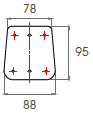 |
| 8×12 | Da 2,70 a 5,80 m | 18 fili = 6 trecce 3×2,25 | 25 kg/m | 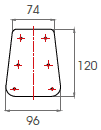 |
| 14×14 | Da 4,20 a 5,80 m | 36 fili = 12 trecce 3×2,25 | 42 kg/m | 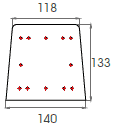 |
We realize tensile structures that requires to be anchored to the ground to grant a permanent tension of the system.
We need therefore elements that, once set in the ground, are able to grant an adequate resistance and stability. They are of different shape and size, to suit the different types of structure and soil.
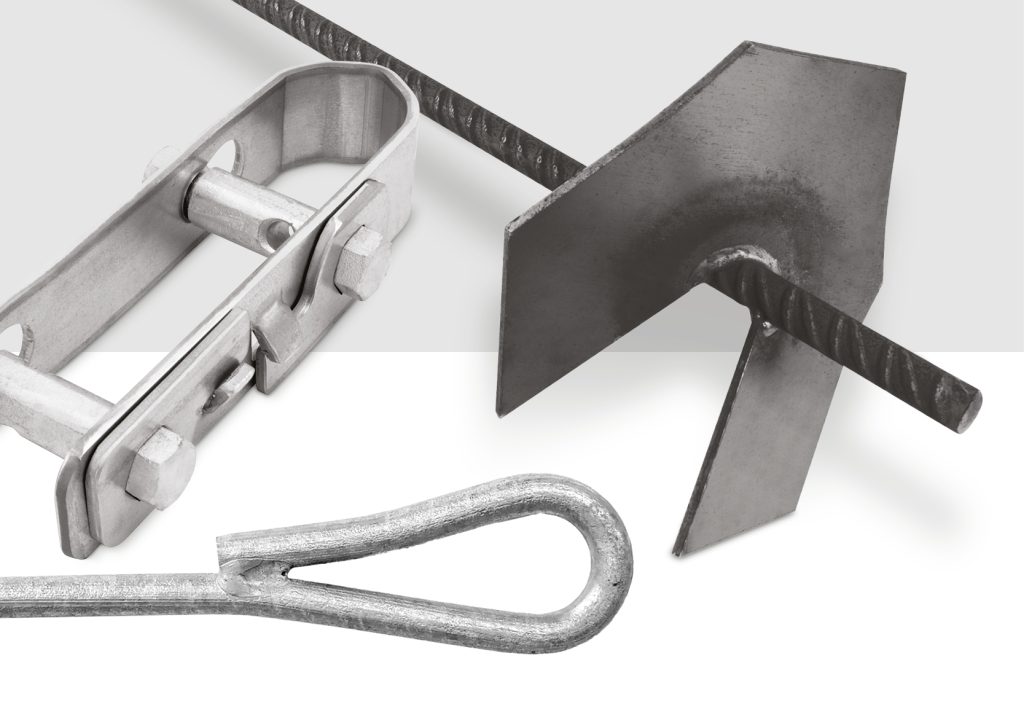
This type of anchorage consists of a rod and a reinforced concrete plate.
It is used when the soil has gravel or rock inside it or in the presence of extremely sandy soils.
The hexagonal anchors are not galvanized because steel thickness and rod diameter are so big to minimize any corrosion damage that might cause product destruction.
This type of anchoring is ideal for the creation of anti-hail, anti-rain or shading covering systems on terrain without gravel or rock.
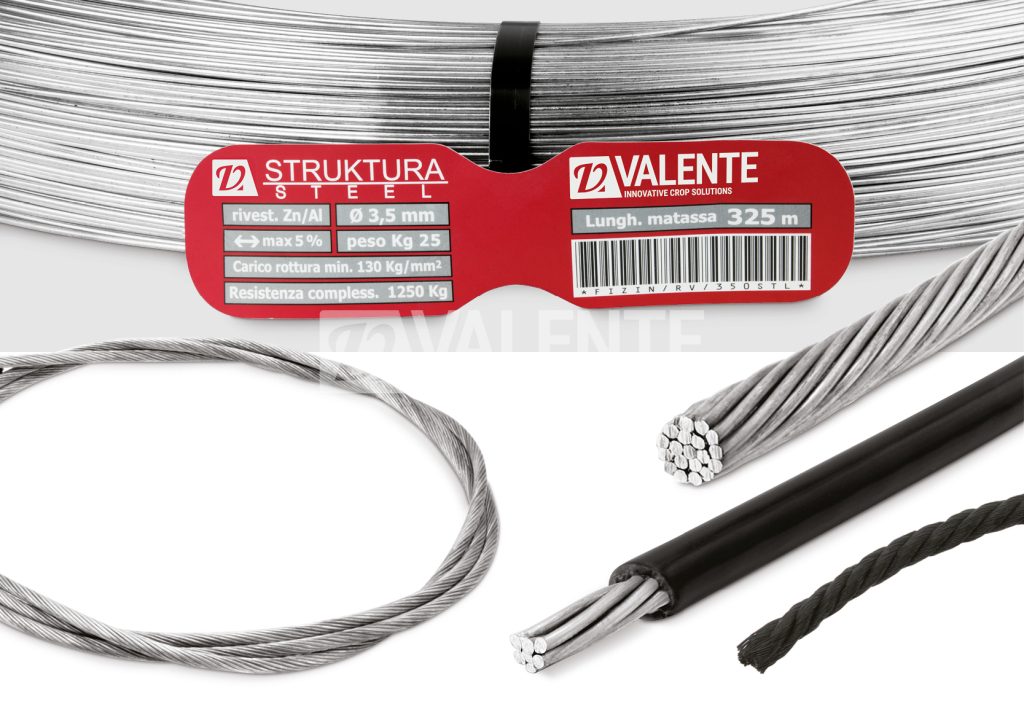
STRUKTURASTEEL steel wire is made of high-carbon steel (greater than 0.6%) coated with a zinc-aluminum alloy. It is drawn in diameters ranging from 1.60 to 4.00 mm and is used to connect all intermediate posts, providing support for plants and securing branches. It is also used to connect the ends of posts when covering them with a covering material, such as hail netting.
Cables are used to connect pile to anchor in systems with rear anchoring. Furthermore, they are used in anti-hail systems for longitudinal and transversal connection of piles, to stabilize the whole structure.
Cables, formed by intertwining wires, are highly flexible and easily adjustable to anchored parts.
Wires quantity depends on cable intended purpose and, consequently, desired resistance.
ROPSTEEL cable can also be supplied galvanized with a black plastic coating so that surface touching the net is perfectly smooth, avoiding net early wear due to brushing on cable.
A cut-to-size cable with slipknot has been created to ease installation operations and make them quicker and safer.
In small fruit crops such as strawberries, blueberries, blackberries, raspberries and currants, various insects can cause significant damage to both the plant and the fruit. Here are the main ones:
The spotted wing drosophila Drosophila suzukii (Diptera: Drosophilidae), native to Southeast Asia, appeared in Europe in 2008 in Spain and Italy, subsequently spreading throughout the continent. In Italy, D. suzukii spread from north to south and to the islands in just a few years.
The Nematus ribesii is a sawfly belonging to the Tenthredinidae family. It is known as a parasite of gooseberries.
The Anthonomus rubi, known as the strawberry or raspberry weevil, is a small curculionid beetle that causes damage particularly to the flower buds of these species.
The Frankliniella occidentalis affects several species, including strawberries, where it causes brown streaks and deformation of the petals and malformation of the fruit. In the most severe attacks, the flowers may abort and the fruit may show browning and blackening of the achenes.
Aphids on small fruits (strawberries, currants, raspberries, etc.)
The Chaetosiphon fragaefoli sucks the sap from strawberry plants. The leaves and fruits become sticky due to the honeydew secreted, on which sooty moulds grow. It is also an important vector of several viruses that affect strawberries (Crinke virus, Mild yellow-edge virus).
The Yellow currant aphid (Cryptomyzus ribis) causes blistering and false galls on the edges of the leaves, which turn a wine-red colour. This damage spreads rapidly to other plants, hindering the development of the
The Cochineal is a small insect similar to aphids that feeds on the sap of currant plants. The honeydew it secretes spreads disease and dirties the berries, reducing their value.
The whitefly belongs to the order Hemiptera. Whiteflies belong to the Aleurodidae family; they suck sap and vector certain viruses. The sugary liquid excreted by the nymphs promotes the appearance of fungi such as sooty mould (a black fungus that disfigures affected plants) on the leaves.
Leaf-eating moths (Lepidoptera): their larvae can damage leaves and compromise blueberry development. The most common are the blueberry bush moth, whose larvae feed on leaves and shoots, and the blueberry moth, which mainly attacks the fruit.
The presence of defoliating moths can be seen by the remains of buds and flowers hanging from thin silk threads.
Beetles and mining larvae can damage blueberries. Adult beetles, such as the Japanese beetle (Popillia japonica), feed on leaves and flowers, causing damage to blueberry production. Mining larvae dig tunnels inside the leaves, and adults feed on leaves and flowers, affecting production.
La rete anti insetto è realizzata dalla tessitura di monofilo plastico e viene utilizzata per coprire e proteggere adeguatamente le colture dai danni causati dagli insetti, soprattutto la DROSOPHILA SUZUKI, la CARPOCAPSA e la CIMICE ASIATICA.
Il materiale utilizzato per la realizzazione delle reti anti insetto è il polietilene ad alta densità (HDPE). Il filo utilizzato è realizzato per estrusione, fondendo e facendo passare attraverso delle griglie forate (estrusori) la materia prima; successivamente viene termostabilizzato, ovvero viene riscaldato per far diminuire tutte le ritrazioni che normalmente presenta il materiale plastico esposto a fonti di calore anche modeste.
La rete antinsetto è realizzata lavorando il monofilo con una particolare tecnica chiamata tessitura a telaio: la maglia che si ottiene con questo tipo di lavorazione è di forma rettangolare di misura variabile ed è indeformabile, cioè le dimensioni non variano quando il telo anti insetto è sottoposto alle sollecitazioni.
Le reti anti insetto sono disponibili nelle seguenti dimensioni:
Rete ANTI-CARPOCAPSA: H 2,50 – 4,00 – 4,60
Rete ANTI-SUZUKI: H 2,00 – 2,50 – 3,00

Anti-hail net is manufactured weaving a plastic monofilament and is used to cover and properly protect crops from damages caused by hail.
Net must be installed and fixed on special structures to provide total protection from bad weather, still maintaining a minimum elasticity to avoid premature material wear.
Material used to make the net is high-density polyethylene (HDPE). Wire used is made by extrusion, melting and passing raw material through perforated grids (extruders); subsequently it is thermostabilized, that is to say heated to reduce all retractions that plastic material exposed to even modest heat sources normally presents.
Anti-hail net is made manufacturing monofilament with a particular technique called “loom weaving”; obtained mesh has a rectangular 2.8 x 8 mm shape and is non-deformable, meaning dimensions don’t change when subjected to hail load.
Net weaving is “Leno weaving”, so mono-wire is woven into weft and warp threads.
Anti-hail net is certified and designed for long-lasting performance. Documentation is provided at purchase.
Actinidia (kiwi) cultivation can be threatened by various phytophagous insects, some of which cause direct damage to the fruit, while others weaken the plant, making it more vulnerable to disease. Here are the main ones:
Argyrotaenia pulchellana (Eulia) is a polyphagous leaf-rolling moth that feeds on the leaves, flowers and fruit of numerous herbaceous and arboreal plants, both cultivated and wild.
Metcalfa pruinosa is a homopteran insect belonging to the Flatida family. It can attack kiwifruit, sucking sap and producing white waxy secretions, expelling the sugary part as honeydew and causing the development of sooty moulds, which facilitate the growth of harmful fungi that cover the leaves and fruit with a black coating, reducing photosynthesis and growth.
Pseudaulacaspis pentagona (white scale insect) can cause damage by piercing the shoots of actinidia, causing stress and weakening the plant. In the most serious cases, the branches dry out and fruiting is compromised. Affected fruit develop a reddish halo around the follicles, causing serious economic damage, as they cannot be sold or exported.
Empoasca vitis (green leafhopper) pierces the leaves of actinidia, altering lymphatic flow and transpiration and causing yellowing that rapidly spreads from newly formed leaves to older ones. Necrosis begins at the edges of the leaves, which then fall off, causing a reduction in photosynthesis.
Panonychus ulmi (red spider mite) can infest kiwifruit in hot, dry weather conditions. Repeated bites from the mites reduce the functionality of the foliage, causing leaf discolouration, premature leaf fall and general weakening of the affected plants.
Autographa gamma: The larvae of these lepidoptera can cause significant damage to actinidia plants as they feed on leaves and shoots, the loss of which reduces and may affect photosynthetic capacity, leading to a subsequent reduction in fruit production and quality.
Halyomorpha halys is an extremely polyphagous species that also affects actinidia plants. In spring, the adults colonise the plants, feed and lay their eggs. The larvae, which go through several stages of development, also feed on the sap of the plants and fruits, causing them to fall and become deformed, thus compromising their marketability.
MONILIA DISEASE OF THE CHERRY TREE
Monilia is one of the most widespread and easily recognisable diseases affecting cherry trees. It is caused by two different parasites, called Monilia laxa and Monilia fruttigena, which thrive in particularly damp soil and when the plant is not pruned and disinfected correctly.
The most dangerous period is spring, when temperatures begin to rise and irrigation may be more abundant, with a higher risk of liquid accumulation and stagnation, which causes the fungus to proliferate.
It is easy to recognise when the leaves, flowers or fruits suddenly become darker, as if covered with a thick, compact layer of grey mould, which tends to rot them from the outside inwards and cause them to fall off.
The branches appear dry, with cracks that are an indication of the disease, inside which spores proliferate and where other variants of different bacteria can also insidiously develop.
CORINEO DISEASE OF THE CHERRY TREE
Corineo is also commonly referred to as shot -hole disease, precisely to emphasise how the disease manifests itself with small spots that tend to affect every part of the plant, starting with the leaves.
The characteristic colour of these anomalies is a reddish-purple that forms a distinctive halo that spreads across the entire surface, causing the leaf or fruit to fall and die.
The disease can also be recognised by the small holes that form inside the halo, as well as on the branches near the buds, which are unable to blossom and therefore transform.
The cherries also show encrustations that are difficult to remove and prevent the fruit from being edible.
This is another fungal disease that occurs mainly in spring, when the temperature is very humid and the spores find fertile ground for proliferation.
BACTERIA CANCER OF THE CHERRY TREE
The name sounds rather threatening, and indeed this is one of the most dangerous diseases that can affect this variety.
In this case, it is not caused by a fungus but by a bacterium, which likes to nestle in various types of stone fruit and lead to their premature death, first drying out the branches at the ends and then reaching the heart of the tree and its roots.
The symptoms of bacterial cancer are dark spots that appear irregularly on the leaves, with lighter, blurred halos and necrotic parts on woody areas such as branches and the trunk.
THE ROTTEN CHERRY TREE
Rottenness is one of the most common diseases affecting cherry trees and is caused by a number of factors.
The first factor is excessive irrigation of soil that is already very moist, which causes puddles and waterlogging, leading to the deterioration of the roots as they extend upwards.
The second factor is certain types of fungi, which manifest themselves in this way and must therefore be treated with sulphur-based products and other antibacterial and antiseptic agents. One of the fungi that most affects cherry trees in the Vignola area and is already present in Puglia is Armillaria mellea, a fungus that appears on the roots with a whitish colouring that can lead to the death of the plants. This is more prevalent in soils where cherry trees have been cultivated for a long time.
To prevent this phenomenon, it is therefore advisable to pay attention to soil preparation, adjusting watering according to weather conditions and pruning dry and diseased parts tactically to prevent them from damaging the fruit.
LEAF SPOT DISEASE OF THE CHERRY TREE
Also known as leaf blight, this disease tends to occur mainly in summer and is caused not by a lack of water, as one might mistakenly think, but by a fungus called Gnomonia erythrostoma.
This misunderstanding often leads to delayed action, but it is possible to recognise the difference by noticing yellow patches with a red halo around them, which tends to darken when the necrosis is already at an advanced stage.
The dry leaf tends to fall off, leaving the plant bare.
As with any other infection of this kind, the key is to use a sulphur-based product or the classic copper sulphate to stop the spores from spreading, taking care to remove any damaged parts that are beyond repair and will only encourage the disease to spread.
LEAF-RUST DISEASE OF THE CHERRY TREE
Similar to the previous disease in terms of symptoms, this disease manifests itself with brownish spots mainly on the upper side of the leaf, which gradually darkens until it dies and falls off.
The disease then spreads to the branches, preventing the buds from blooming and thus preventing fruit formation.
The white pustules that accompany this condition can be defeated with a copper-based spray, which is disinfectant and antifungal, combined with a sulphur component for a stronger action.
BLACK APHIDS ON THE CHERRY TREE
This is a disease that can be easily recognised, as it develops following infestation by small black insects that are visible to the naked eye.
These insects bite the shoots of cherry trees and other fruit trees, depositing a large number of other young aphids that do the same thing.
The tree will die quickly if immediate action is not taken, resulting in small, deformed and inedible cherries.
The only solution is to use a specific insecticide or have the tree professionally treated by a pest control expert.
In cherry orchards, various insects can compromise the quality and yield of cherries. Here are the main pests to watch out for:
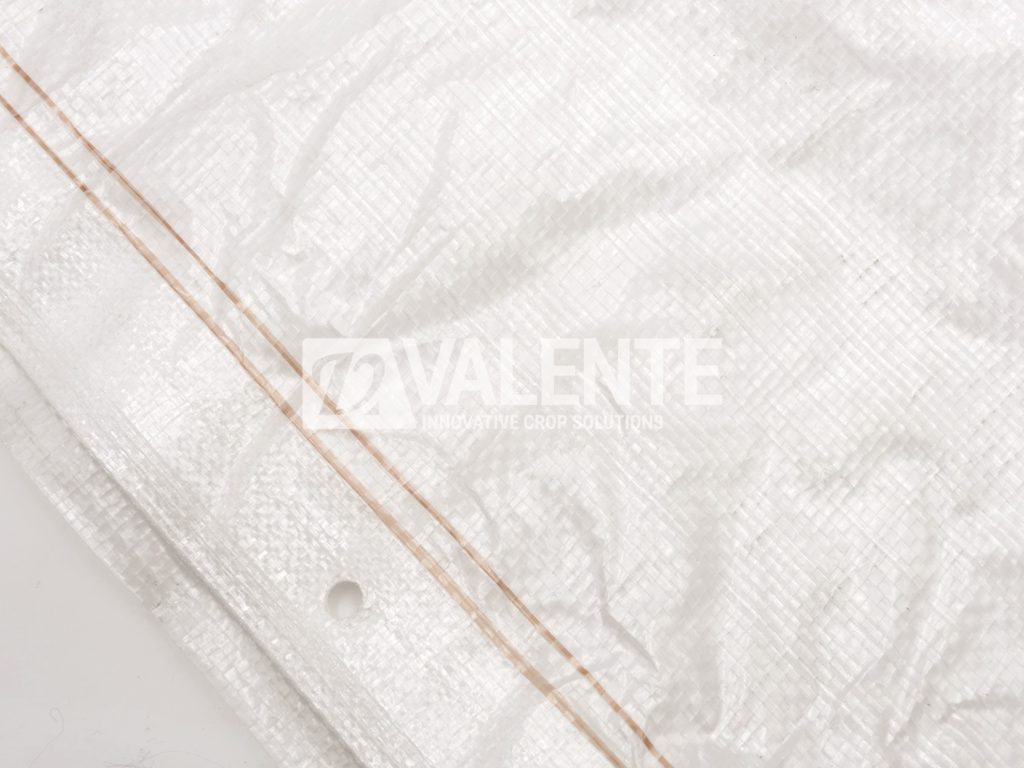
The rainproof film is a raffia fabric plastic-coated on one side and is used to cover and adequately protect crops from damage caused by rain.
Through a patented welding process, reinforced side selvedges (triple layer of fabric) are applied, essential for secure attachment to the structure; the entire film is waterproof, has considerable mechanical strength and tear resistance.
In addition, perforations are made along the edge of the film so that hooks or carabiners can be inserted to secure it to the structure.
The technical characteristics of the rainproof film are as follows:
Valente offers a quick and automatic system that allows rain covers to be opened and closed like an umbrella, for optimal cherry orchard management.
This innovative technology, installed exclusively on the Multishield structure, offers great advantages and represents a complete, effective, flexible and safe solution for farmers to protect their crops.
The particular arrangement of the Multishield system's covers allows the operator to slide them along the frame of the structure, so that they can be opened and closed as needed, with the great advantage of allowing the plants to grow in normal conditions for most of the time, covering them only when necessary, i.e. when there is a real risk of rain, thus promoting the best development.
The Valente system makes this operation quick and effective, allowing a single worker to close or open the cover much faster than manual systems.
Peach and apricot orchards are susceptible to various harmful insects that can compromise the quality and quantity of the harvest.
On peach trees, damage is mostly during harvest time; attacks during flowering and fruit set only happen in protected crops, while they are rare for open field crops. The damage is only cosmetic and shows up as discolouration of the skin, mostly on nectarine cultivars, where it can seriously depreciate the product.
Insects
The use of orchard coverings, now common practice for most crops grown using modern farming methods, actually has a fairly recent history. In the 1960s, when our company entered the market with the production of pre-stressed reinforced concrete poles, the idea of covering orchards was certainly not a priority for farmers, but, as is now clear, many things have changed in just over 60 years.
Starting in the 1980s, besides hail protection, other needs emerged such as protection from insects, rain, wind and sun.
Thanks to the experience we've gained over the years, two other new aspects have emerged that are proving to be fundamental.
The first is that these coverings, in addition to fulfilling their specific functions, can actually be multifunctional, i.e. capable of performing multiple tasks and offering different types of protection.
The second is that coverings also guarantee a better microclimate for crops in various ways, creating a more favourable environment for plant growth and increasing fruit productivity and quality.
Scientific literature on this subject is now quite extensive and, although necessary distinctions must be made regarding the type of coverings, cultivation and characteristics of different territories, it agrees on confirming the benefits in relation to the following parameters.
These are vital benefits, especially when we consider that the environmental situation is continuing to evolve and become more complicated, with mild winters and late frosts, concentrated and more intense rainfall, frequent hailstorms, excessive wind and sunlight, and an increase in alien pathogens.
This scenario leads to one conclusion: fruit growing without orchard covering systems is now unimaginable.
Obviously, there are different types of solutions, from traditional anti-hail systems to multifunctional ones complete with insect nets, single-wire or monobloc systems with different levels of automation, but all of them have a positive impact. Despite representing a significant initial investment, they bring long-term benefits in terms of improved quality and quantity of production that more than justify the costs.

In apple and pear orchards, various insects and fungi can cause significant damage to both the plants and the fruit. Here are the main ones:
Apple tree
Pear Tree
Mushrooms
The most common fungal diseases affecting apples and pears are:
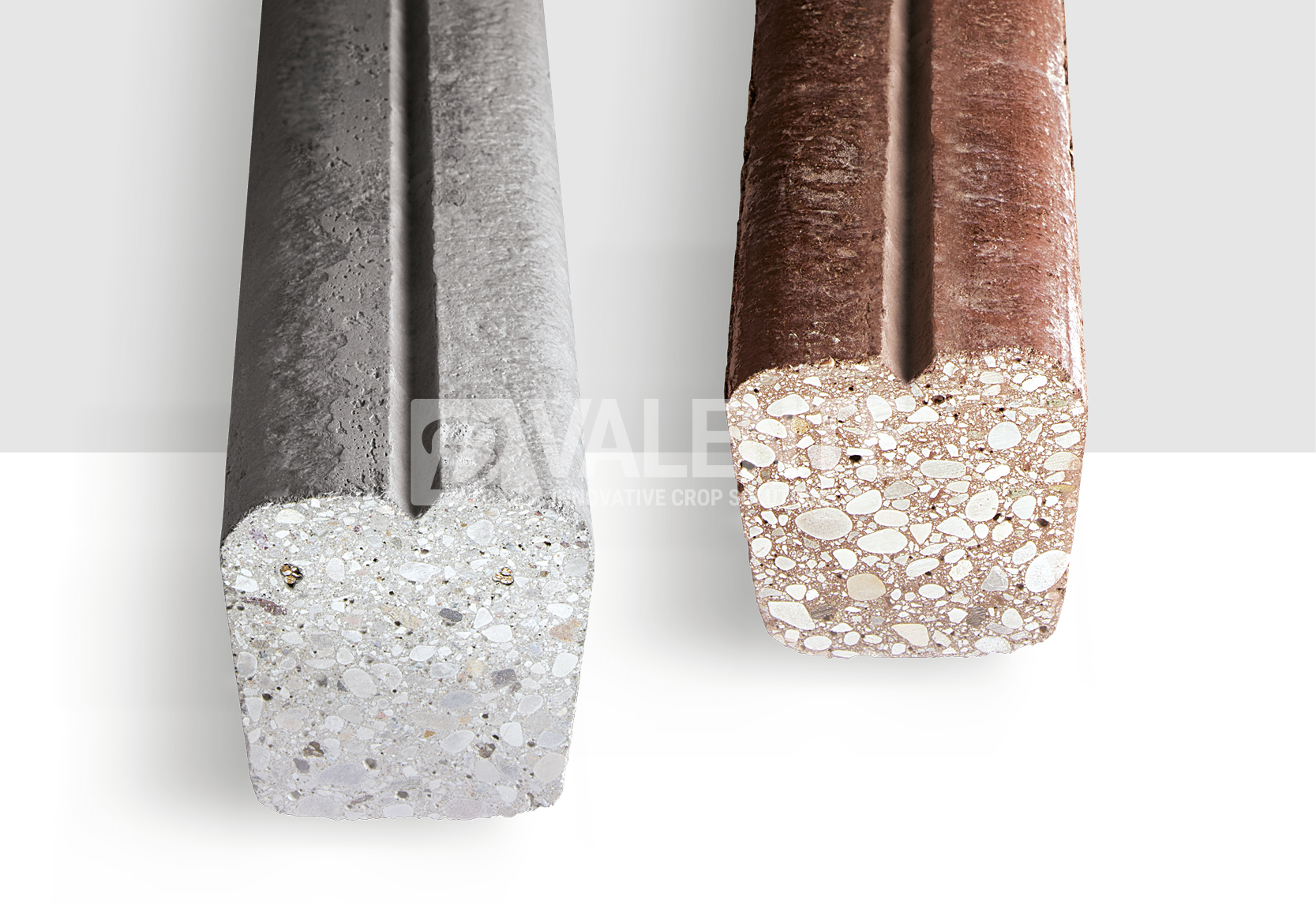
Prestressed Reinforced Concrete poles are made using pre-tensioning technique, which ensures a greater mechanical resistance.
Valente pole has a trapezoidal shape with four smooth sides and no edges, so not to wear hail nets out in orchard installations. Our trademark is on the front: V for Valente!
Valente pre-stressed cement piles are realized with the wize combination of two fundamental components: concrete (natural gravel and sand mixed with PORTLAND 525 cement) and the high carbon content steel braid with low relaxation (made of two or three braided wires with a diameter of 2.25 mm).
The quality of Valente poles are guaranteed by DNV through Product Quality Certificate.
The poles are available in the KLASSIC version in grey or brown and in 9 sections, with heights from 2 m to 5.8 m.